-1.png)

2026新加坡光电子大会 (已结束)
2026年2月5日 9:00 - 17:30 (8:45开始入场)
Conference Room
主办机构
LUX Photonics Consortium
合办机构
National Centre for Advanced Integrated Photonics (NCAIP)
National Semiconductor Translation and Innovation Centre (NSTIC)
会议介绍
LUX光电产业联盟携手新加坡国家先进集成光子学中心(NCAIP)及国家半导体转化与创新中心(NSTIC),诚邀您参加2026新加坡光电子大会。
会议将于2026年2月5日在亚洲光电博览会Conference Room举行,主题定为“集成光子学的下一个前沿”。 本次全天活动汇聚了多位国际与本地重量级嘉宾,将带来精彩演讲、充分交流的茶歇环节,以及学术界与产业界领军人物的专题对话。
特邀讲者包括Abdallah Ougazzaden 教授(佐治亚理工学院)、Peter O’ Brien 教授(廷德尔国家研究院)、Rho Junsuk 教授(浦项科技大学)、Jurgen Michel 博士(麻省理工学院)、Luigi Ranno 博士(Ayar Labs)等国际专家学者,及新加坡本地NCAIP、NSTIC和NUS的专家学者。
活动将以一场产业专题讨论收官,并设有仅限受邀嘉宾参加的专属晚宴(席位有限)。 这将是您拓展行业人脉、促进合作共赢的宝贵机会。
期待与您共赴光子学的未来之约!
大会主席: Prof Tan Chuan Seng (Nanyang Technological University Singapore)
大会联合主席: Nanyang Assistant Prof Chae Sanghoon and Assistant Prof Sia Jia Xu Brian (Nanyang Technological University Singapore)
会议议程
| 2026 新加坡光电子大会 | ||
| 时间 | 演讲主题 | 演讲嘉宾 |
| 8:45-9:30 | Registration & Networking Breakfast | |
| 9:30-9:40 | Welcome Address by Conference Chair, Prof Chuan Seng Tan | |
| Session 1: Pioneering the Next Horizon Innovation Frontiers in Integrated Photonics Moderator: Prof Chuan Seng Tan/Prof Brian Sia |
||
| 9:40-10:10 | Photonic-Electronic Co-packaging and Addressing Production Scale-up Challenges through Design Standardisation and Pilot Lines | Prof Peter O'Brien |
| 10:10-10:40 | 2D hBN for GaN Technologies: Scalable Epitaxy, Micro-LEDs, and Deep-UV Advances | Prof Abdallah Ougazzaden |
| 10:40-11:10 | Optical Metasurfaces for Imaging, Sensing, and Display | Prof Junsuk Rho |
| 11:10-11:40 | Flat Optics Technologies | Dr Arseniy Kuznetsov |
| 11:40-12:40 | Lunch | |
| Session 2: Pushing the Boundaries: New Material Platforms for Next-Generation Photonic Integrated Circuits Moderator: Prof Sanghoon Chae |
||
| 12:40-13:10 | Device Performance of BEOL Ge Epitaxy on Si Devices | Dr Jurgen Michel |
| 13:10–13:40 | On-chip SNSPDs for Quantum Photonics and Single-photon Imaging | Prof Cesare Soci |
| 13:40–14:10 | Electrically-pumped Topological Photonic Crystals Lasers | Prof Qijie Wang |
| 14:10–14:40 | Tea Break | |
| Session 3: Advancing High-speed, Low-power Silicon Photonics for Next-generation Chips and Architectures Moderator: Dr Satrio Wicaksono |
||
| 14:40-15:10 | Progress in Nanophotonics Sensors and Photonics Computing | Prof Chengkuo Lee |
| 15:10–15:40 | Silicon Photonics Heterogeneous Integration (Si-PHI) - Augmenting Performance through Multi-Material Integration | Dr Xianshu Luo |
| 15:40–16:10 | Chip-Scale Unification of the Terahertz and the Megahertz | Prof Brian Sia |
| 16:10–16:20 | Bio Break | |
| Session 4: Integration, Innovation, and Impact: The Evolving Landscape of Integrated Photonics Moderator: Prof Chuan Seng Tan |
||
| 16:20-17:20 | Panel Discussion | Prof Peter O'Brien (TNI), Dr Jurgen Michel (MIT), Dr Mian Zheng (HyperLight), Mr Richard Hueners (Palomar) |
| 17:20–17:30 | Closing Remark | Prof Chuan Seng Tan |
| 17:30 | End of Conference | |
| 17:30–18:15 | Post Conference Cocktail | |
| 18:15 | End of Cocktail | |
演讲嘉宾

Prof Peter O’Brien
Head of the Photonics Packaging & Systems Integration Group
Tyndall National Institute, University College Cork, Ireland
Presentation Title: Photonic-Electronic Co-packaging and Addressing Production Scale-up Challenges through Design Standardisation and Pilot Lines.
Abstract: The talk will present some of the latest developments in photonic and electronic packaging technologies, and how these technologies can transition from research to pilot-scale manufacturing. Particular focus will be given to packaging materials such as glass, the co-design of packaging processes with equipment development, and the development of standardised process design kits. The talk will also highlight important research initiatives in advanced packaging, particularly the recently launched European Pilot Lines, which aim to address the challenges of transitioning advanced packaging research to manufacturing-scale-up.
Bio: Prof. Peter O’Brien is Head of the Photonics Packaging & Systems Integration Group at the Tyndall Institute, University College Cork, Ireland. He is also Director of the European Photonics Pilot Line (PIXAPP), Leader of Advanced Packaging in the new EU Chips Act Photonics Pilot Line (PIXEurope), and Director of the European Photonics Academy. Prof. O’Brien previously founded and served as CEO of a start-up manufacturing specialty photonic systems for biomedical applications, which he sold in 2009. He was a postdoctoral researcher at the California Institute of Technology and a research scientist at NASA’s Jet Propulsion Laboratory, where he developed submillimetre-wave devices for remote sensing applications. He received his degree and PhD in Physics from Trinity College Dublin and University College Cork, respectively.
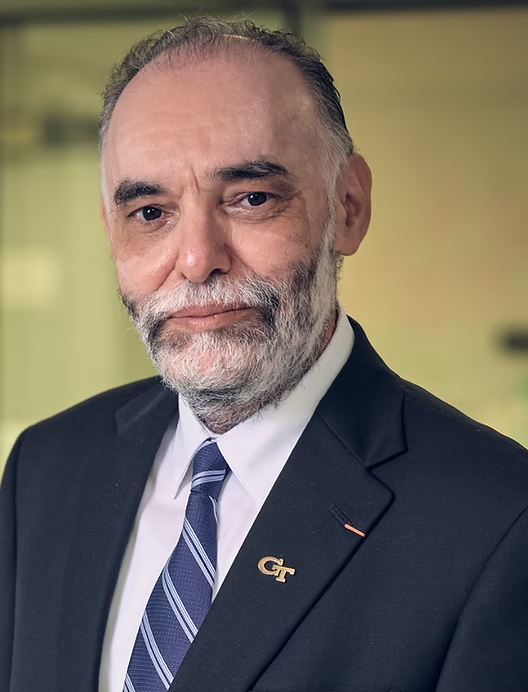
Prof Abdallah Ougazzaden
President of Georgia Tech-Europe, Professor
Georgia Institute of Technology
Presentation Title: 2D hBN for GaN Technologies: Scalable Epitaxy, Micro-LEDs, and Deep-UV Advances
Abstract: Hexagonal boron nitride (h-BN), a two-dimensional ultrawide-bandgap semiconductor, is emerging as a foundational platform for next-generation III-nitride optoelectronics. Its weak van der Waals interface enables scalable epitaxial growth, mechanical release, and transfer of freestanding GaN-based heterostructures, supporting heterogeneous integration and flexible device architectures. Recent advances include MOVPE growth of h-BN and III-nitride heterostructures on 6-inch wafers, membrane liftoff of LEDs, and transfer onto arbitrary substrates. Vertical integration of RGB micro-LEDs grown on h-BN and graphene further enables full-color micro-LED displays. A selective-area van der Waals epitaxy approach yields detachable micro-LEDs from 100 μm down to 1.4 μm with smooth, as-grown sidewalls and well-defined facets; these devices can be released as membranes and transferred without degradation. Beyond its role as a template, h-BN also functions as an active material: Mg-doped h-BN can replace p-AlGaN to achieve electrically injected emission near 290 nm, offering a promising route to efficient deep-UV LEDs.
Bio: Dr. Abdallah Ougazzaden is President of Georgia Tech-Europe in France, Co-Founder and Co-President of the Lafayette Institute, and a Professor in ECE School at the Georgia Institute of Technology. With over 30 years of experience in semiconductor and optoelectronic research, he began his career at CNET/France Telecom, later working at Optoplus/Alcatel and Bell Labs in the United States, where he led semiconductor materials programs for high-speed optical communications. He subsequently held management positions at Agere Systems and TriQuint (now Qorvo). Joining Georgia Tech in 2005 as a tenured professor, he helped create the GT-CNRS International Research Laboratory at GTE and served as its director for 12 years. His research focuses on wide bandgap semiconductors and 2D materials. He has authored more than 500 publications and holds 30 patents. His distinctions include the Légion d’Honneur (2019), the Stellab Award (2015), and Georgia Tech’s Steven A. Denning Award (2013).
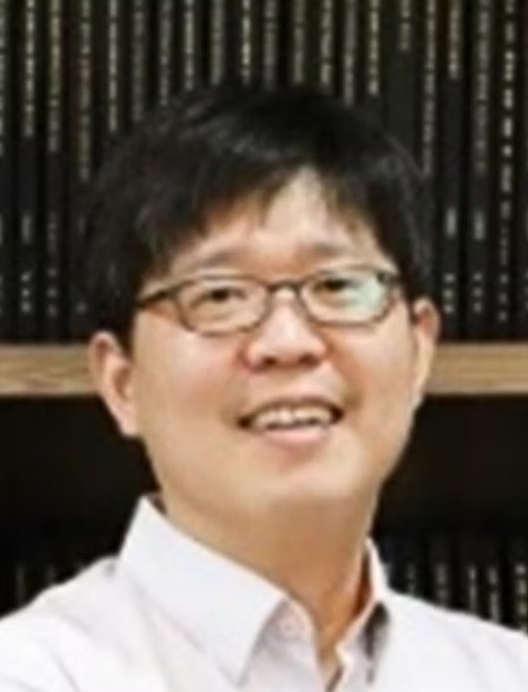
Prof Junsuk Rho
Yeon-San (延山) Endowed Chair Professor, Mu-Eun-Jae (无垠斋) Endowed Chair Professor
Pohang University of Science and Technology (POSTECH)
Presentation Title: Optical Metasurfaces for Imaging, Sensing, and Display
Abstract: Metasurfaces, composed of nanostructure arrays, enable high-resolution imaging across various wavelengths from UV to acoustic waves, with applications in displays, sensors, and bio-imaging. While design and manufacturing challenges exist, emerging fabrication methods like nanoimprint lithography and photolithography are advancing their commercialization potentials.
Bio: Prof. Rho is a Yeon-San (延山) Endowed Chair Professor and Mu-Eun-Jae (无垠斋) Endowed Chair Professor at Pohang University of Science and Technology (POSTECH), Korea, with a joint appointment in the Department of Chemical Engineering, Mechanical Engineering, and Electrical Engineering. He received his Ph.D. at the University of California, Berkeley (2013), M.S. at the University of Illinois, Urbana-Champaign (2008) and B.S. at Seoul National University, Korea (2007) all in Mechanical Engineering. Prior joining POSTECH, he conducted postdoctoral research in Materials Sciences Division & Molecular Foundry at Lawrence Berkeley National Laboratory, and also worked as a principal investigator (Ugo Fano Fellow) in Nanoscience and Technology Division & the Center for Nanoscale Materials at Argonne National Laboratory.

Prof Brian Sia Jia Xu
Assistant Professor
Nanyang Technological University Singapore
Presentation Title: Chip-Scale Unification of the Terahertz and the Megahertz
Abstract: Photonics and electronics operate in the terahertz and megahertz, vastly different frequency regimes. We have invented a cohesive framework that will enable us to interface these two frequency regimes by building coherence intrinsically, into the system itself, introducing an alternative paradigm for opto-electronic integration where ultra-low phase nose is demonstrated.
Bio: Brian Sia is an assistant professor at School of EEE, NTU. His interests include GPS-free navigation, coherent radar, photonic-RF transmission, THz-GHz/MHz interface paradigms, leveraging ultra-coherent lasers and integrated photonics as the driving platform. To date, patents authored by Brian have been the subject of licensing fees from industry in excess of 900,000 SGD. Brian serves as the consultant to deep-tech startups in Southeast Asia and the US. Brian’s work have been featured in numerous news outlets such as MIT news.
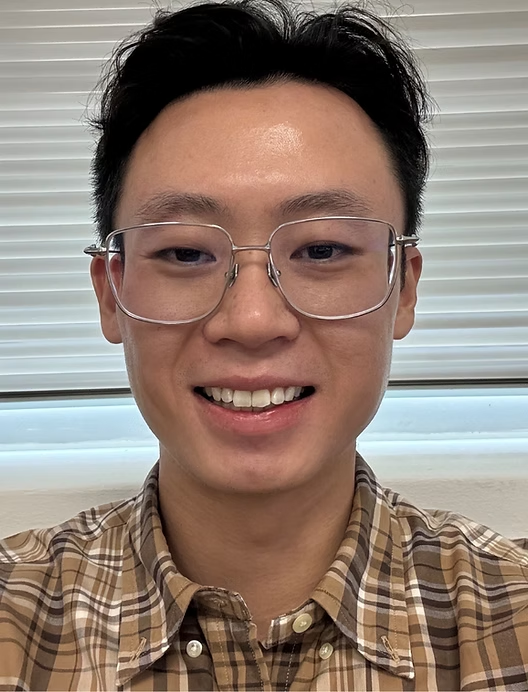
Prof Brian Sia Jia Xu
Assistant Professor
School of Electrical & Electronic Engineering
Nanyang Technological University Singapore &
National Centre for Advanced Integrated Photonics
Presentation Title: Chip-Scale Unification of the Terahertz and the Megahertz
Abstract: Photonics and electronics operate in the terahertz and megahertz, vastly different frequency regimes. We have invented a cohesive framework that will enable us to interface these two frequency regimes by building coherence intrinsically, into the system itself, introducing an alternative paradigm for opto-electronic integration where ultra-low phase nose is demonstrated.
Bio: Brian Sia is an assistant professor at School of EEE, NTU. His interests include GPS-free navigation, coherent radar, photonic-RF transmission, THz-GHz/MHz interface paradigms, leveraging ultra-coherent lasers and integrated photonics as the driving platform. To date, patents authored by Brian have been the subject of licensing fees from industry in excess of 900,000 SGD. Brian serves as the consultant to deep-tech startups in Southeast Asia and the US. Brian’s work have been featured in numerous news outlets such as MIT news.
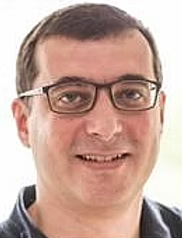
Prof Cesare Soci
Professor of Photonics
Nanyang Technological University Singapore
Presentation Title: On-chip SNSPDs for Quantum Photonics and Single-photon Imaging
Abstract: Superconducting nanowire single-photon detectors (SNSPDs) have become the gold standard for single-photon detection, combining broadband high efficiency with ultra-low dark counts, rapid recovery, and excellent timing jitter. Their performance underpins both fundamental quantum optics and an expanding range of quantum and classical photonic technologies. In this talk, I will present our recent advances in materials heterointegration and nanophotonic design that enable compact on-chip detectors, photon-number resolution, and quantum-state tomography. I will also highlight emerging applications in classical photonics, including single-photon imaging and LiDAR, where SNSPDs are pushing the limits of sensitivity and long-range performance.
Bio: Cesare Soci is an applied physicist specializing in optical spectroscopy and nanophotonics. He earned his Laurea and Ph.D. in Physics from the University of Pavia, followed by postdoctoral appointments at the University of California, Santa Barbara (2005-2006) and the University of California, San Diego (2006-2009). He joined Nanyang Technological University (NTU) in 2009, where he holds joint appointments in SPMS and EEE. At NTU, he leads the Optical Science of Nanomaterials & Nanophotonic Technologies (OSON) laboratory and serves as Acting Director of the Centre for Disruptive Photonic Technologies. His research spans nanowire detectors, integrated photonics, light-emitting metasurfaces, and other optoelectronic devices. He is a Fellow of the Institute of Physics Singapore (IPS), Optica (formerly OSA), and SPIE.
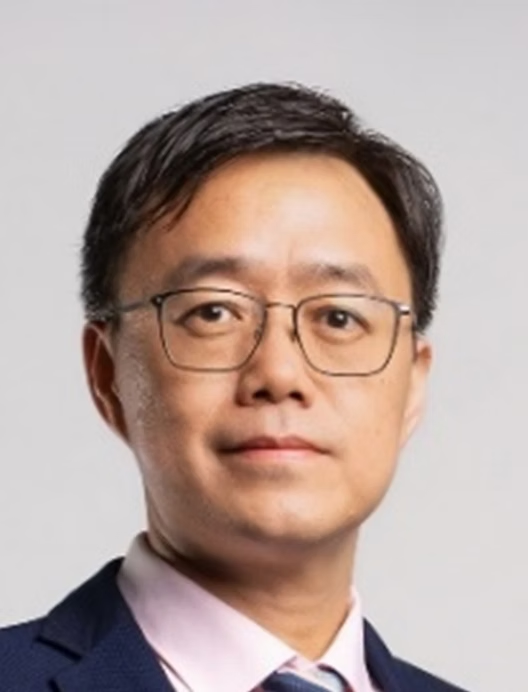
Prof Qijie Wang
President Chair Professor
Nanyang Technological University Singapore
Presentation Title: Electrically-pumped Topological Photonic Crystals Lasers
Abstract: In electrically-pumped semiconductor lasers, microfabricated structures like photonic crystals have been employed to reduce device footprints. Recently, topological concepts have been integrated into the design of photonic crystal lasers, enabling unprecedented robustness to perturbations and unique laser performance. In this talk, I will present how band topology, which is invariant under small deformations, generates robust topological lasing states in semiconductor laser flatforms. In addition, I will introduce how photonic crystals lasers are designed using other promising topological concepts, such as Dirac vortex (or Majorana zero) cavities and topologically nontrivial flatband bound states in the continuum (BICs), for achieving robustness of lasing frequencies, structural beam engineering, and miniaturization while maintaining good laser performance.
Bio: Prof. WANG Qijie is a President Chair Professor in Optoelectronics at the School of Electrical and Electronic Engineering (EEE) and the School of Physical and Mathematical Sciences (SPMS) NTU. He is an Optica Fellow. He is a co-recipient of the Institution of Engineers Singapore, Prestigious Engineering Achievement Team Award of Singapore Twice in 2005 and 2017, respectively, the prestigious Singapore Young Scientist Award 2014, Nanyang Research Award 2015 (Young Investigator), ARC Sciences Nanotechnology Medal and Prize, 2021, and NTU College of Engineering Research Excellence Award, 2022.

Dr Arseniy Kuznetsov
Vice President
National Semiconductor Translation and Innovation Center (NSTIC)
Presentation Title: Flat Optics Technologies
Abstract: Metasurfaces present an exciting opportunity to replace conventional bulk optical components with much more compact and functional flat optics, which can be manufactured at large scale using conventional semiconductor nanofabrication. In National Semiconductor Translation and Innovation Center (NSTIC) we are developing flat optics design and manufacturing processes to translate this new technological platform to industrial products. In this talk, I will highlight our research and translational capabilities and show several examples of developed flat optical technologies, including high-efficiency focusing lenses for visible light, wide-field-of-view imaging camera modules for visible and near-IR, hyperspectral imagers, 1-micron-pixel liquid crystal displays for AR glasses and directional micro-LEDs.
Bio: Arseniy Kuznetsov received his double PhD degree from University of Paris 13 (France) in 2005 and from Institute of Applied Physics RAS (Russia) in 2006. Since 2007 till 2011 he worked at the Laser Zentrum Hannover (Germany) as Humboldt Research Fellow. Since October 2011 till now he has been working in A*STAR (Singapore) where he is currently appointed as Senior Principal Scientist, Director of Optics and Electronics Division, and Vice President of the National Semiconductor Translation and Innovation Center (NSTIC). His R&D and management activities are devoted to development of novel nanodevices based on dielectric nanoantennas and metasurfaces. He is an author of >100 journal papers and a co-inventor of >20 filed patent applications. For his pioneering research on dielectric nanoantennas and metasurfaces, he was awarded 2016 IET A F Harvey Engineering Research Prize and 2017 NRF Investigatorship Award. In 2020 he was elected to be an Optica Fellow.

Dr Xianshu Luo
Principal Scientist
Institute of Microelectronics, A*STAR
Presentation Title: Silicon Photonics Heterogeneous Integration (Si-PHI) – Augmenting Performance Through Multi-Material Integration
Abstract: Silicon photonics heterogeneous integration (Si-PHI) enables performance beyond the limits of silicon by incorporating multiple best-in-class materials – such as III–V, SiN, and lithium niobate – onto a common platform. Si-PHI is poised to enable next-generation optical communication, computing, and sensing systems by combining the strengths of diverse material platforms into a unified silicon photonics ecosystem. This presentation will highlight recent technology advances in multi-material integration, covering process innovations, platform development, and demonstrations of various devices using Si-PHI. We will also discuss emerging opportunities toward scalable manufacturing.
Bio: Dr. Luo received his Ph.D. in Electrical and Computer Engineering from The Hong Kong University of Science and Technology (HKUST) in 2010, specializing in silicon photonics. He began his career as a Scientist at A*STAR’s Institute of Microelectronics (IME), focusing on silicon photonic integrated circuits (Si-PICs) and heterogeneous optoelectronic integration. In 2017, he co-founded Advanced Micro Foundry (AMF), where he led the development of silicon photonics integration platforms and Process Design Kits (PDKs). He returned to IME in 2023 as a Principal Scientist and, in 2024, was appointed Head of the Photonics & Sensors Department at IME and Vice President of Silicon Photonics Platform Technology at the National Semiconductor Translation and Innovation Centre (NSTIC), where he leads the development of next-generation silicon photonics heterogeneous integration. Dr. Luo is a Fellow of Optica, a Senior Member of IEEE, a Lifetime Member of SPIE, and a member of PMI. He currently serves as editorial board member of SPIE Advanced Photonics Nexus. He previously served as Associate Editor of Optica Photonics Research (2022 – 2025) and IEEE Photonics Technology Letters (2020–2024) and Guest Editor of the IEEE Journal of Selected Topics in Quantum Electronics Focus Issue on Hybrid Integration for Silicon Photonics (2020–2022). He also actively contributes to major international conferences such as the IEEE Photonics Conference and the IEEE Silicon Photonics Conference, Asia Communications and Photonics Conference, etc. He has authored or co-authored over 200 publications, contributed to 5 book chapters, and holds more than 30 patents.
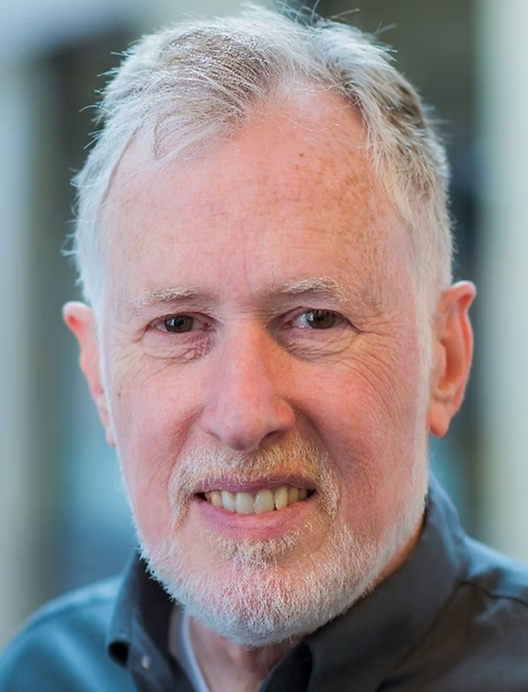
Dr Jurgen Michel
Senior Research Scientist
Massachusetts Institute of Technology
Presentation Title: Device Performance of BEOL Ge Epitaxy on Si Devices
Abstract: Integration of near-infrared photodetectors in the back-end-of-line requires low temperature growth of Ge (<450 C). We have developed low temperature epitaxial growth of Ge on Si using commercial tools and processes. We have fabricated high performance, vertical incidence Ge-on-Si photodiodes under these thermal budget constraints with as-grown diodes achieving high IQE and low dark current densities at 1310 nm. The photodiode design incorporates a uni-traveling-carrier (UTC) design, demonstrating that Ge material quality is sufficiently high for minority carriers to diffuse to the Ge/Si interface. Post-growth annealing up to 550 C was applied to improve device performance. Low-temperature grown Ge-on-Si photodiodes give comparable performance to diodes processed at high temperatures despite thermal budget constraints.
Bio: Dr. Michel received his PhD from the University of Paderborn in Germany. After conduction post-doctoral research at the AT&T Bell Laboratories, he moved to MIT to conduct research on Si-based microphotonic devices, eventually specializing in Ge-on-Si integration. He has published more than 300 refereed scientific papers, 5 book chapters, and more than 30 awarded patents.
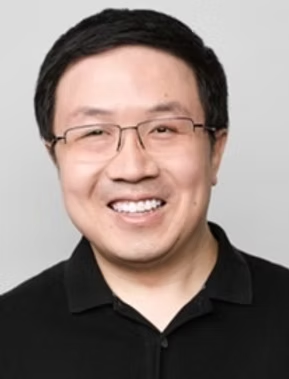
Dr Zhang Mian
CEO & Co-Founder
HyperLight Corporation
Mian Zhang is co-founder and CEO of HyperLight Corporation, which provides high performance photonic integrated circuits product and solutions for AI/Data center infrastructure, telecom networks, industrial equipment and emerging applications. Before founding HyperLight, Mian was a researcher at Harvard University, where he laid the groundwork in thin film lithium niobate photonics technology. Prior to that, Mian obtained his PhD of Applied Physics from Cornell University working in silicon photonics.

Mr Richard Hueners
CEO & Co-Founder
Chief Commercial Officer
Palomar Technologies
Rich Hueners is the Chief Commercial Officer at Palomar Technologies, Inc. and Managing Director of Palomar’s Asia Pacific operation. Based in Singapore since 2013, Rich has been instrumental in driving the company’s strategic vision for its core automated bonding equipment portfolio and in particular by establishing Palomar’s regional Asia assembly-as-a-service operation. Through these business lines, Palomar engages with large MNCs and smaller, cutting-edge startups companies on their complex packaging and assembly requirements, gaining continuous insight into best process and material practices.